At a Glance: |
|---|
On published rates, QR Ph payments cost about 1.0% with GCash for Business and from 1.0% with Maya Business: PHP 100 to PHP 125 in fees on PHP 10,000 of in-store QR sales. Cards cost 3.2% to 3.5%. GCash lets a small seller start with a verified GCash account at least 12 months old and no business papers. |
QR Ph is not a third rival to GCash and Maya. It is the national QR standard, launched under Bangko Sentral ng Pilipinas (BSP) guidance, and GCash and Maya both support it.
So for a sari-sari store, canteen or small shop, the real questions are who issues your QR code, what they charge, and when the money reaches your bank. Every number below comes from official provider, InstaPay operator or BIR pages, read November 5, 2026.
How much do GCash, Maya and QR Ph charge a small shop?
About the same on QR, and more on cards.
What you compare | GCash for Business | Maya Business | QR Ph (BSP standard) |
|---|---|---|---|
In-store QR fee | 1.0%, VAT-inclusive | From 1.0%; 1.25% in-store, 1.60% online on its QR Ph page | Set by your provider; the customer pays none |
Card fee | 3.2% | 3.50% (plus PHP 10 per online payment) | QR only |
Setup and monthly | None, unless your contract says so | Free QR kit; Maya Terminal PHP 949 a month | Ask your provider |
Who can sign up | Individual sellers (Starter); registered businesses (Premium) | Not published; apply at business.maya.ph | Ask your bank or e-money issuer |
When money lands | GCash wallet in real time | QR: not published; terminal: next banking day | Your provider's schedule |
Cost to move it to your bank | Free by PESONet | Not listed | Depends on your account |
Sources, read November 5, 2026: GCash Help Center, GCash fees page (updated September 10, 2026), Maya pricing, Maya QR Ph FAQ, Maya Terminal, PPMI InstaPay page (the InstaPay operator).

Each provider's own pages disagree. GCash's Help Center says 1.0% for QR Ph, but its fees page lists 0.8% for QRPH via SoundPay. Maya's pricing page says QR Ph "starts at" 1.0%, but its QR Ph page says 1.25% in-store and 1.60% online (one FAQ there says 1.60% for every QR Ph payment). Neither Maya page says whether VAT is included.
QR Ph itself is free for the customer, and the InstaPay operator tells merchants to ask their own bank or e-money issuer for the service. What you pay is the provider's rate, so get it in writing.
What does PHP 10,000 of QR sales cost in fees?
Say a payday brings in PHP 10,000, all paid by in-store QR.
GCash at 1.0%: the fee is PHP 100, so you keep PHP 9,900. At the 0.8% on its fees page, it is PHP 80.
Maya at 1.0%: the fee is also PHP 100. At 1.25% in-store it is PHP 125, so you keep PHP 9,875. At 1.60% online, PHP 160.
The same sales on cards: PHP 320 with GCash (3.2%), PHP 350 with Maya (3.50%).
Over a month, PHP 150,000 of QR sales costs PHP 1,500 at 1.0% and PHP 1,875 at 1.25%, a gap of PHP 375. Maya Terminal adds PHP 949 a month, but it also takes cards.
Who can sign up, and what papers do you need?
GCash for Business has two wallet tiers. Starter is for small businesses and individual sellers. You need a fully verified GCash account active for 12 months or more, and no business documents are reviewed.
Premium is for registered businesses. A sole proprietor uploads a DTI Certificate of Registration, a BIR Certificate of Registration (Form 2303) and a 9-digit TIN. The tier also decides which products you can activate.
Maya Business publishes no document checklist or eligibility rule. You apply at business.maya.ph, so ask Maya which papers it wants before you apply.
QR Ph: the InstaPay operator says to ask your own bank or e-money issuer, and that small businesses do not need costly equipment such as a POS machine.
When does the money reach your bank?
It depends on who issued your QR code.
GCash: payments are credited to your wallet in real time. A PESONet transfer to your bank is free of charge and usually lands the same day if sent before the banking-day cut-off, otherwise the next banking day.
Maya: there is no published payout schedule for QR payments. For terminals, proceeds reach your bank the next banking day, with no settlements on weekends or holidays (page dated October 26, 2026).
QR Ph: payments run on InstaPay, which works 24/7, weekends and holidays included, per its operator. Your provider decides when the money reaches your bank.

So a Friday sale may only reach your bank on Monday. Tax can come off too: under BIR RR 16-2023, as amended by RR 5-2025 (February 27, 2025), e-wallet providers withhold 0.5% of what they remit once a merchant's remittances for the year pass PHP 500,000. It is a creditable tax, so ask your accountant how to claim it.
Our view at StoreHub
The fee is the easy part, because it shows on your statement.
The end-of-day count is harder. QR money reaches your bank net of the fee, on a different day for each provider, while your sales record shows the full amounts.
So we would pick the provider whose payments you can match to the day's sales fastest, and compare rates second. And never accept a customer's screenshot as proof: GCash's own Help Center says to keep the goods if a customer was charged but the payment is not in your portal.
What helps: a free end-of-day QR checklist
Copy this into a notebook or a phone note.
Write down the day's sales by payment type: cash, QR and card.
In each provider's dashboard, note the QR total and the fee taken.
Check the dashboard total against the QR line in your sales record. Gross minus fee should equal the credit.
Chase any payment that does not match. Contact the provider with its reference number.
On the next banking day, match bank credits to the dashboard totals.
Each month, check the statement against QR sales x your contract rate (PHP 150,000 x 1.0% = PHP 1,500).
Keep an invoice record for every sale (BIR RMC 77-2024).
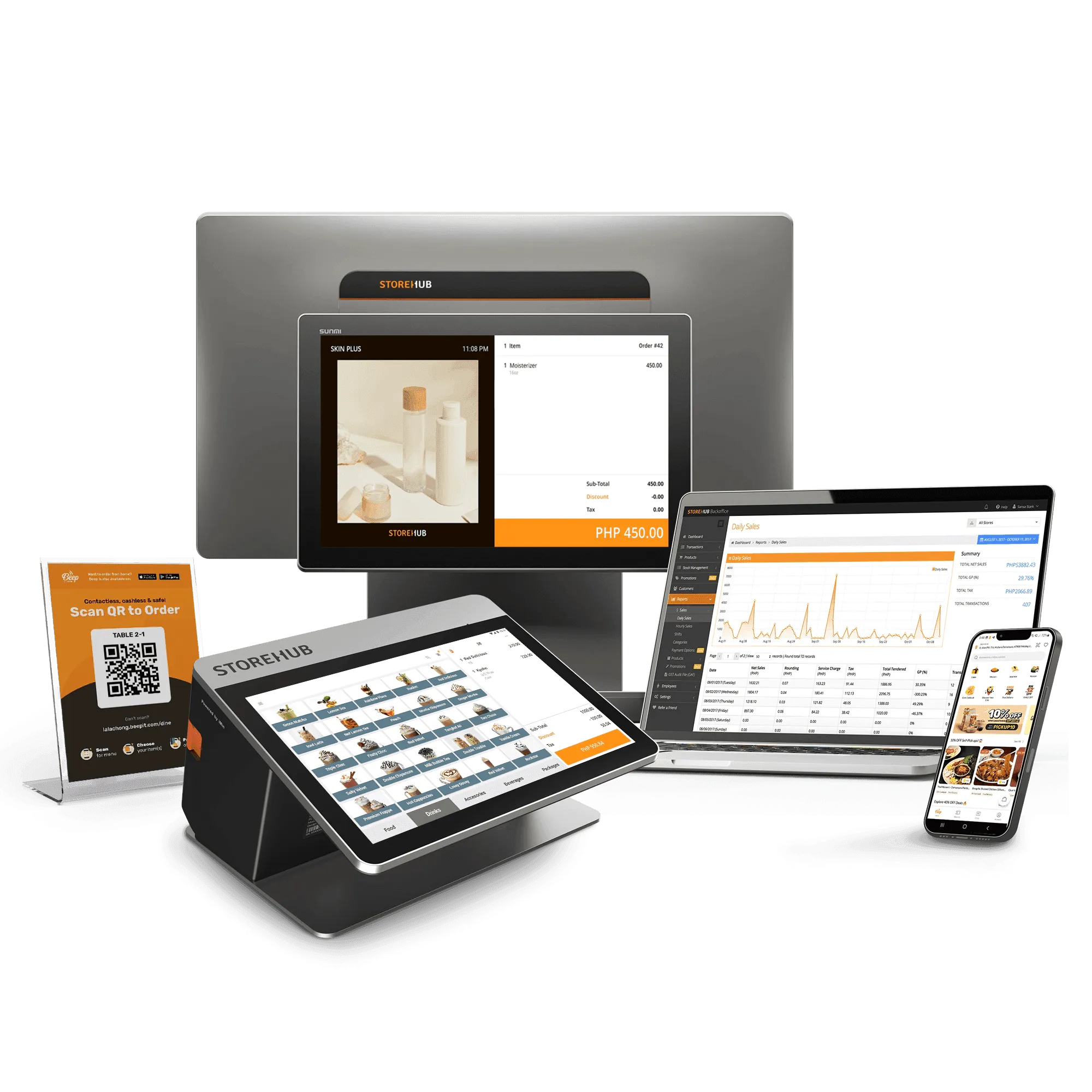
With a StoreHub POS, you can accept GCash, Maya, GrabPay and bank transfers with one QR code, as our payments page shows. QR Ph is an addition to your payment options, not a replacement.
Those payments are recorded in the same POS as your cash and card sales, so step 3 starts from one place. Ask StoreHub for the current rate card before you sign.
Our QR Ph launch note explains how that QR works. Running a counter-service shop? See our food kiosk, canteen and convenience store guides.

Frequently asked questions
How much do GCash for Business and Maya Business charge per QR payment?
GCash charges about 1.0%, VAT-inclusive, per its Help Center, though its fees page lists 0.8% for QRPH via SoundPay. Maya's pricing page says QR rates start at 1.0%, and its QR Ph page says 1.25% in-store and 1.60% online (all read November 5, 2026). Use the rate in your contract.
Can a sari-sari store without DTI registration use GCash for Business?
Yes, with the Starter wallet, according to GCash. It lists unregistered businesses among those who can sign up, and Starter reviews no business documents. Registering with DTI and BIR is still a separate duty, so check with DTI and your BIR Revenue District Office (RDO).
Does a QR or e-wallet sale still need an invoice?
Yes, a QR sale is a sale like any other. As we read BIR RMC 77-2024, non-VAT sellers invoice sales of PHP 500 or more, any sale a buyer asks an invoice for, and the day's smaller sales in aggregate. Rules change, so confirm with your RDO.
Is QR Ph the same as GCash?
No. QR Ph is the national QR standard, and GCash and Maya are providers that support it (PPMI, the InstaPay operator). A customer pays no fee, and what you pay is set by the provider that issued your code.
See StoreHub in action
See how StoreHub runs across 20,000+ Southeast Asian businesses. Book a free demo for a live walk-through.