At a Glance: |
|---|
A canteen POS in the Philippines has three jobs: ring up orders in seconds through the lunch rush, take GCash and QR Ph on the same screen as the order, and close the day with clean numbers and BIR-compliant receipts. StoreHub is a BIR-accredited cloud POS built for that pace, with orders in under 30 seconds and staff trained in 15 minutes. Filipino F&B operators like Happilee Korean Kitchen and Candid Coffee run on it. |
For canteen and food court operators in the Philippines, the POS choice comes down to two things. How fast the line moves between 11:30 and 1:00, and how clean the numbers are when the shift closes. StoreHub is built for counter-service speed, BIR-accredited from day one, and takes GCash, Maya, and QR Ph through the POS itself. More than 20,000 businesses across Southeast Asia run on it, including Happilee Korean Kitchen, Candid Coffee, and The Weekend in Cebu.
A canteen’s economics are unlike a restaurant’s. Revenue concentrates into one short window, tickets are small, and the customers are the same office workers and students every day. Whether you run a school cafeteria in Quezon City, a stall in an SM food court, or the canteen concession in an Ortigas office tower, the register is where the operation keeps up or falls behind.
This guide covers what a canteen POS actually needs to do, where the daily friction lives for concessionaires, and how the same setup handles the food court case. A canteen management system, in practice, is this same stack: POS, payments, staff time tracking, and reporting.
Are these problems familiar in your canteen or food court stall?
The lunch window is 90 minutes, and the line decides your revenue
Between 11:30 and 1:00, a canteen does most of its day. Every extra 20 seconds at the register is someone at the back of the line deciding to eat somewhere else, and there is no dinner service to win it back. A slow register makes the counter the bottleneck instead of the kitchen.
The GCash standee and the cash drawer live in separate worlds
Most canteens went cashless the quick way: a printed QR standee taped beside the register. It works, but the payment lands in a wallet app the POS never sees. Closing means reconciling the cash drawer, the wallet balance, and the handwritten tally. When they disagree, nobody can say which order went missing.
End-of-day is an hour of counting, every day
A canteen day is hundreds of small tickets. When the tally is manual, the person who ran the counter through the rush is also the one doing arithmetic at 8 pm, and a shortage found on Friday could have happened any day that week.
Shift handovers are a black box
Morning and afternoon cashiers swap mid-day. Without sales tracked per staff member, a short drawer belongs to everyone and no one. And because canteen crews rotate with semesters and contracts, a complicated POS charges a training tax on every new hire.
What to look for in a canteen POS in the Philippines
Before picking a system, check that it covers all of these:
Counter-service speed. Order-to-receipt in seconds with quick keys. StoreHub’s quick-serve setup processes orders in under 30 seconds.
Integrated cashless payments. GCash, Maya, GrabPay, QR Ph, and bank payment apps accepted through the POS, so every cashless sale attaches to an order.
Staff clock-in records and per-staff sales. Clock-ins and clock-outs tracked directly from the POS, timesheet reports, and sales tied to whoever rang them.
Daily reports you can read from your phone. Sales by item, hour, and staff member, without building a spreadsheet at closing.
A kitchen display for cooked-to-order counters. Orders route to station screens in real time instead of shouted numbers and paper stubs.
BIR accreditation, including the mall case. Official Receipts, Z-readings, X-readings, and e-journals generated automatically, plus mall pre-accreditation for stalls inside SM, Ayala, or Robinsons food courts.
How StoreHub solves these for canteen and food court operators
Orders in under 30 seconds, even at 12:15
StoreHub’s quick-serve setup is built for counter service. Orders process in under 30 seconds, and new staff train in about 15 minutes, which matters when the crew changes every semester. The line clears instead of walking away.
GCash, Maya, and QR Ph on the same screen as the order
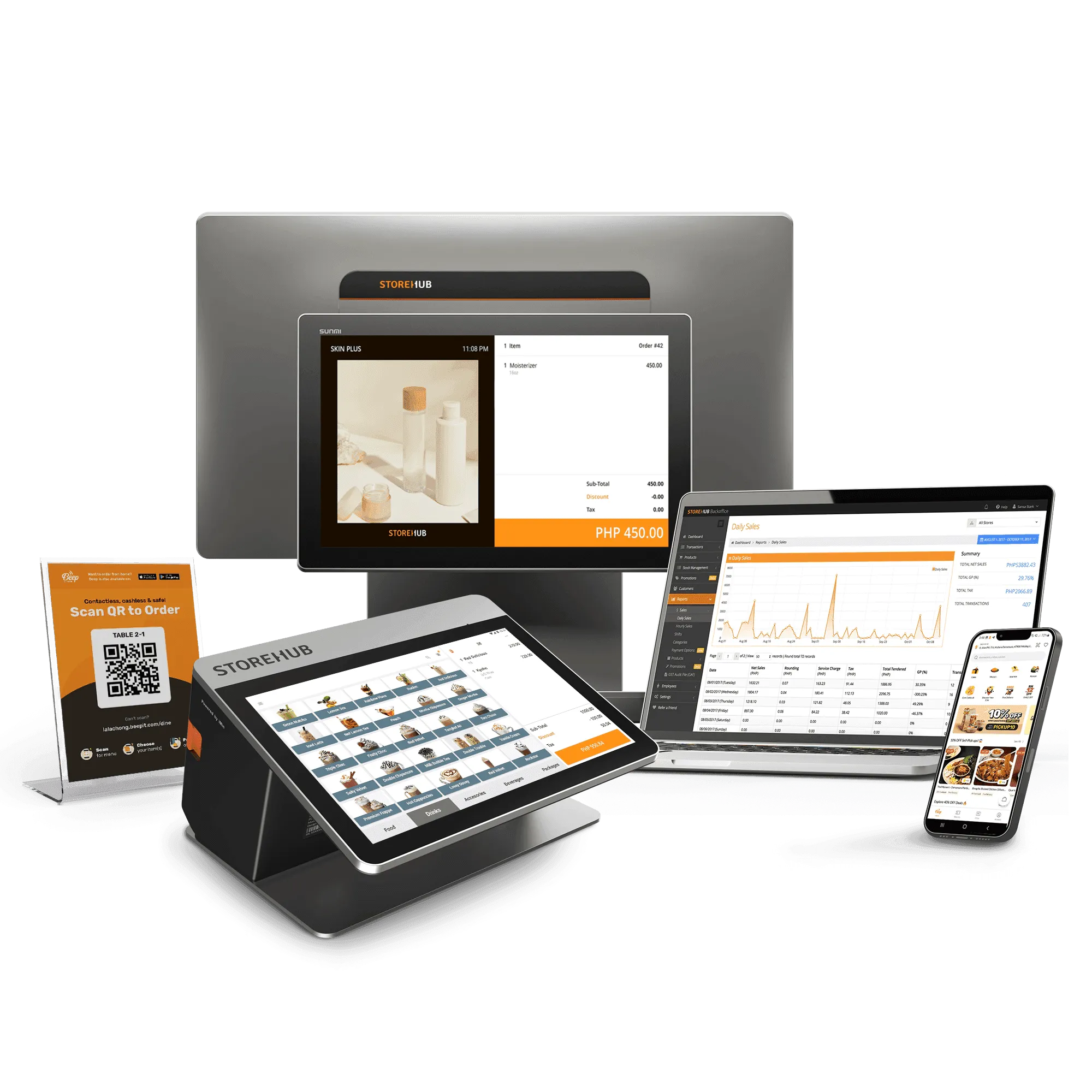
StoreHub accepts GCash, Maya, GrabPay, QR Ph, and bank payment apps through the POS itself. The payment attaches to the order it paid for, so the wallet-versus-tally reconciliation stops being a nightly job. Cash still works as it always has; the drawer count just gets shorter.
End-of-day numbers without the 8 pm tally
Reporting analytics breaks the day down by item, hour, and staff member, viewable from any device. A concessionaire in a Makati food court can watch the lunch peak from anywhere, and closing becomes checking a report instead of building one.
Staff clock-ins, shifts, and per-staff sales built in
Employee management tracks clock-ins and clock-outs directly from the POS and keeps timesheet reports for every shift. Sales tie to the staff member who rang them, so a shift handover comes with its own numbers.
A kitchen display keeps the back line in sync
For counters cooking to order (silog plates, noodle bowls, the day’s ulam specials), the Kitchen Display System routes orders to station-specific screens in real time. No shouted orders, no lost stubs.
BIR receipts and mall accreditation handled
StoreHub is BIR-accredited: Official Receipts, Z-readings, X-readings, and e-journals generate automatically, in the format examiners expect. For food court stalls, StoreHub is also pre-accredited with major Philippine mall chains, which saves 30 to 60 days versus registering yourself.
Built for Filipino canteen and food court operations specifically
The quick-serve hub documents the counter-service feature set in full. Three specifics worth calling out.
Reliability at the only hour that matters. StoreHub has run at 99.9% uptime. A register that freezes at noon costs you the day, not an hour. Local Philippine support picks up mid-service.
Reporting your mall lease can live with. Many food court agreements ask concessionaires to report sales to the mall operator. Clean daily reports per stall turn that into a pull, not a project.
If your setup is a cart, not a counter. A standalone food cart or kiosk needs compact hardware and day-one simplicity. We cover that setup in the food kiosk POS guide for the Philippines.
Voices from Filipino F&B operators on StoreHub
StoreHub’s published Philippine merchant stories come from restaurants and cafes rather than canteens, and we attribute them that way. But two things these operators keep raising are exactly what concessionaires wrestle with daily: a system fast enough for F&B service, and knowing the day’s numbers without staying late.
On choosing a system fast enough for F&B service:
“I explored many POS options, but none were enough for a growing business. I needed something BIR-accredited, fast, and F&B-friendly. After almost two years with StoreHub, it’s proven to be the perfect fit for us.”
Jona Lee, Co-Founder of Happilee Korean Kitchen
→ See StoreHub for F&B businesses
The other half of the pitch is the 8 pm tally:
“We used to spend eight hours sorting through data manually. With StoreHub, we get it done in under 30 minutes, freeing up our time for other parts of the business.”
Lanz Castillo, Owner of Candid Coffee
→ See StoreHub inventory management
The reliability side shows up in Google Reviews on StoreHub’s Philippine homepage, where the rating sits at 4.7 out of 5. Reviewer Kim Pena puts it plainly: “Used StoreHub for 2 years with no issues. System is straightforward.”
More than 20,000 businesses across Southeast Asia run on StoreHub. The Philippine F&B roster includes Happilee Korean Kitchen, Candid Coffee, Yardstick Coffee, The Weekend in Cebu, Wagyu Studio, and others. Each runs StoreHub because it’s built for the way Filipino food businesses actually run, through every lunch peak, every shift handover, and every BIR Z-reading.
When StoreHub is not the right choice
Like any system, StoreHub fits some merchants better than others. Picture a family carinderia in Caloocan serving forty lunches a day, cash only, one steam table, no plans for a food court stall or a second counter. For that setup, a free POS like Loyverse on a tablet is the honest recommendation. It’s simpler, it’s cheaper, and it does what they need.
But if you’re feeding an office tower through a 90-minute window, taking GCash at the counter, or opening inside a mall food court that requires accredited receipts, that’s where StoreHub starts to matter, because adding those later means switching systems mid-service.
StoreHub pricing in the Philippines
Three plans cover most canteen and food court operations.
Plan | Annual | Best for |
|---|---|---|
Starter | PHP 26,988/yr | A single canteen counter or one food court stall |
Advanced | PHP 53,988/yr | Concessionaires running more than one stall, or canteens that need deeper inventory and reporting |
Pro | PHP 107,988/yr | Larger operations that want a full-service setup |
A 14-day free trial is available, no credit card required. BIR PTU Registration assistance is PHP 1,000 per registration as an onboarding service. See our pricing page for add-ons, payment rates, and multi-year savings. For a line-by-line look at what a POS costs to run, including hardware, read our restaurant POS price guide for the Philippines.
Frequently asked questions
What is the best canteen POS system in the Philippines?
The one that clears the lunch line and closes the day cleanly. In practice that means counter-service speed (StoreHub processes orders in under 30 seconds), cashless payments through the POS itself, staff clock-in records with sales per staff member, and BIR-accredited receipts. Judge any system, StoreHub included, against those four jobs.
Can a canteen POS accept GCash and Maya payments?
Yes. StoreHub accepts GCash, Maya, GrabPay, QR Ph, and bank payment apps through the POS, so a cashless sale is recorded against the order that generated it, with no separate wallet-app reconciliation at closing.
Does StoreHub work for food court stalls inside malls?
Yes. Each stall generates its own Official Receipts, Z-readings, X-readings, and e-journals automatically. StoreHub is also pre-accredited with major Philippine mall chains, which saves 30 to 60 days versus handling mall POS accreditation yourself.
How much does a canteen POS system cost in the Philippines?
StoreHub starts at PHP 26,988 per year for a single register, billed annually, with integrated payments and BIR accreditation included. Multi-outlet features for concessionaires running several stalls unlock on Advanced at PHP 53,988 per year. A 14-day free trial is available, no credit card required.
See StoreHub in action
See how StoreHub runs across 20,000+ Southeast Asian businesses, from single-stall operators to multi-branch F&B groups, in this short product walk-through.