At a Glance: |
|---|
StoreHub is a BIR-accredited, cloud-based POS built for fine dining in the Philippines, with modifier-driven order entry, recipe-level inventory, and remote visibility for the owner-chef. Fine dining is a different operation from quick-serve: pacing and premium ingredient cost decide the margin, and a wrong order in front of an anniversary table is a loss, not a hiccup. The Weekend in Cebu runs on StoreHub. |
For fine dining operators in the Philippines, the POS choice comes down to two questions: does it stay invisible to the guest experience, and does it give the owner control without forcing them on the floor every service. StoreHub is BIR-accredited, cloud-based, and cuts order errors by 90% on the F&B floor. More than 20,000 businesses across Southeast Asia run on it, including The Weekend in Cebu.
The shape of the fine dining problem is different from quick-serve or casual restaurants. A guest at a 12-cover BGC tasting menu has paid for a 2.5-hour experience, not a 25-minute one. The pacing of plates, the temperature of the wagyu, the timing of the wine pour, and the silence at the table when something is wrong are all part of what they came for. The POS sits behind all of that, and when it works, the guest never thinks about it.
This guide covers what fine dining in the Philippines actually requires from a POS, where the daily friction lives in premium restaurant operations, and how The Weekend in Cebu uses StoreHub to track sales and monitor performance remotely.
Are these problems familiar in your fine dining operation?
A miskeyed modifier reaches the table
In quick-serve, a wrong drink is a remake. In fine dining, a wrong protein temperature on a wagyu steak is a comped course, a comped table, and a guest who quietly does not return. The POS has to make modifier entry close to impossible to get wrong. Free-text fields, generic ticket flows, and "send a slack to the kitchen" workarounds break the moment service goes from busy to full.
Premium ingredient cost lives or dies on tracking accuracy
Fine dining margin is built on a small number of expensive items. A USDA Prime ribeye, a wagyu A5 portion, a half-kilo of fresh uni, a bottle of single-malt by the glass. If your POS does not track ingredient-level usage per cover, you cannot tell what your true food cost is. By the time the monthly count comes back, the difference is already on your books and you are guessing at the cause.
BIR compliance is non-negotiable at the price point
A PHP 4,500 tasting menu and a PHP 35,000 wine pour have to land on a BIR-compliant sales invoice or you lose the corporate clients, the credit-card-on-file regulars, and the SM Foundation event. A POS that "exports for BIR" instead of being accredited at the system level is a problem waiting to happen at the next BIR examiner visit.
The owner-chef cannot be on the floor every service
In fine dining, the founder is often the chef, the sommelier, and the host depending on the night. Past the first 6 months of operations, the founder needs to be able to step away for a Tuesday off, a sourcing trip to Japan, or a pop-up at another venue, without losing visibility into what is happening at the home restaurant. Cloud-based, remote-monitoring POS is the difference between a sustainable founder and one who burns out by year 2.
What to look for in a fine dining POS in the Philippines
Before picking a system, check that it covers all of these:
BIR-accredited at the system level. Generates Z-readings, X-readings, e-journals, and sales invoices in the format BIR examiners expect. Provider-level accreditation means you do not apply separately as a merchant.
Modifier-driven order entry, not free-text. Cook temperatures, allergen swaps, sauce-on-the-side, wine-pairing changes should be tap-through choices, not typed notes the kitchen has to re-read.
Composite (recipe-level) inventory. Track the ribeye, the uni, the single-malt by the ounce, not just the dish as a SKU. Your food cost per cover should be a number you can pull, not a guess at month-end.
Kitchen Display System. Tickets route to the right station automatically (cold pass, hot line, pastry, expo). Eliminates the printer-jam and the lost-ticket failure modes.
Tableside ordering with QR Order & Pay. Guests scan, order at their own pace and pay when they're ready, and every order goes straight to the kitchen and the POS.
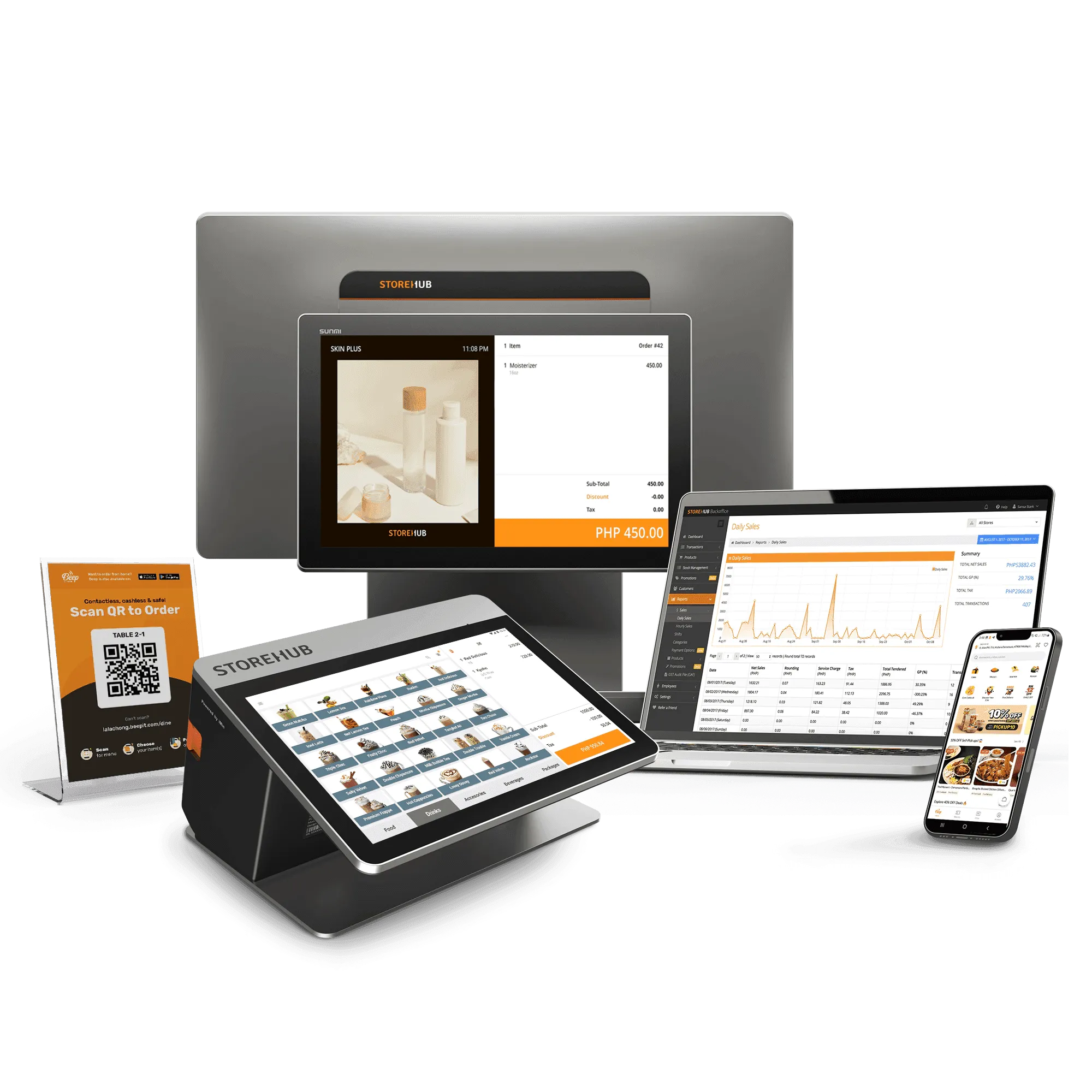
Cloud-based with remote monitoring. Owner-chef can pull sales, item-mix, and cover counts from anywhere, phone, laptop, tablet, without needing to log into a back-office machine on premises.
Mall integration. For fine dining inside a mall in BGC, Rockwell, or Newport, ask whether the mall needs its own POS setup on top of BIR's, and which malls the vendor already integrates with.
A local Philippine support team. Dinner service is exactly when a failure hurts most. International providers without a local team leave you waiting while covers back up.
How StoreHub solves these for Filipino fine dining
Order accuracy at 90%+ during full service
StoreHub's F&B POS is built around modifier-driven order entry. Temperature, allergen, side, garnish, wine pairing are tap-through buttons, not free-text fields. The result is a documented 90% reduction in order errors versus paper-ticket or generic-POS workflows, which compounds on a fine dining floor because every error is a guest-experience hit.
Remote monitoring that the owner-chef actually uses
Cloud-based architecture is what makes off-site visibility possible. Sales, item-mix, and cover counts pull from any phone, laptop, or tablet, without logging into a back-office machine on premises. That off-site visibility is the operational unlock. Most fine dining founders carry the operation in their head, and the POS becomes a way to step away without losing the thread.
BIR-accredited at the level that matters for fine dining
StoreHub is BIR-accredited at the system level. Each register generates Z-readings, X-readings, and e-journals automatically. Under RR 11-2024, an Official Receipt now only proves payment, and the invoice records the sale; StoreHub receipts print in the BIR sales invoice format, showing your machine and permit details plus a running invoice number. The provider-level accreditation means you do not apply separately as a merchant, which removes one of the biggest setup hurdles for a premium dining room.
Premium ingredient tracking that closes the food-cost gap
Inventory management tracks ingredients at recipe level. A wagyu A5 portion deducts when the dish leaves the pass. A 25ml pour of single-malt deducts when the drink is served. Across a 60-cover Saturday service, the data work that used to take hours of reconciliation runs automatically. StoreHub documents a 70% waste reduction across F&B operators who adopt recipe-level inventory. On the floor, it also tells the team which items are moving and which are not.
Cloud-first because that's the standard now
Cloud is the requirement from day one for a serious fine dining build, not a v2 upgrade. The benchmark holds across fine dining globally. Tokyo, Hong Kong, Singapore, the cloud-based, modifier-driven, remote-monitorable POS is the operating standard. Building on it from opening day means the service team never has to re-learn the floor when the operation scales.
Reliability at the price point your guests expect
StoreHub comes with a 99.9% uptime guarantee. Fine dining cannot afford the "the system is down" moment in front of a 12-cover tasting menu. A local Philippine support team picks up when service hits a problem mid-seating.
Built for Filipino fine dining specifically
The Fine Dining and Specialty F&B hub documents the full feature set. A few specifics worth calling out.
Kitchen Display System with station routing. KDS sends tickets to the right station automatically, cold pass, hot line, pastry, expo, and tracks ticket times so the floor manager can see when a course is dragging before the guest notices.
Tableside split-bill handling. Multi-cover bills are split by item, by person, or evenly, and StoreHub processes multiple cards at the same table simultaneously. No one waits at the front while the manager works out who had the wagyu.
Mall integration for Rockwell, Ayala Malls, and more. StoreHub integrates with malls including Rockwell, Ayala Malls, SM, Megaworld, and Fort Bonifacio Development Corp. Each store needs a mall integration license, which StoreHub's Customer Care team sets up.
Beep Delivery at 9% commission for the dining room that runs a takeout or pop-up program. Most third-party platforms in the Philippines take 25% to 35% commission. The gap between 9% and 30% on a PHP 3,500 wagyu bento order is the difference between running a delivery channel as a margin contributor or a brand-awareness loss leader. Online ordering setup ships per location.
Voices from Filipino fine dining operators on StoreHub
Behind every premium dining room is an owner-chef who decided to back themselves. One thing keeps coming up: running the restaurant without being there every service.
On running the restaurant from off-site:
"The old saying goes: the owners must be at the store to ensure that the store runs smoothly. That's no longer true nowadays. If you need to be at the restaurant, you'll never grow your business."
Jan Rodriguez, Owner of The Weekend, Cebu
→ Read Jan Rodriguez's story on The Weekend
More than 20,000 businesses across Southeast Asia run on StoreHub. The Philippine F&B roster includes The Weekend and Ilaputi in Cebu, Candid Coffee, Yardstick Coffee, Happilee Korean Kitchen, Boxed Blossoms, and others. Each one switched because the system they had wasn't built for the way they actually run, through every full service and every BIR filing.
When StoreHub is not the right choice
Like any system, StoreHub fits some operators better than others. Picture a 12-seat omakase counter in Quezon City run by a single chef-owner with a fixed daily menu and no expansion plans. For that setup, a paper kitchen ticket and a basic till would run the operation honestly, the food cost is predictable per cover, BIR can be handled on a simple register, and the chef does not need remote visibility because they are on the line every service.
But if you're already running a premium tasting menu program, a wine list that needs by-the-glass tracking, a private dining room with table-of-12 split bills, or a sister venue you cannot be at every night, that's where StoreHub starts to matter, because adding a real POS layer later means re-training a service team that has already learned the workaround.
StoreHub pricing in the Philippines
Three plans cover most fine dining operations. Advanced is the typical fit for a single-location fine dining restaurant; Pro for a group running multiple premium venues.
Plan | From | Best for |
|---|---|---|
Starter | PHP 2,249/month | Single-concept casual dining or solo founder validating the menu |
Advanced | PHP 4,499/month | Most single-location fine dining restaurants |
Pro | PHP 8,999/month | Premium F&B groups with multiple venues that want a full-service setup |
A 14-day free trial is available, no credit card required. Every plan includes one register and one store. See our pricing page for add-ons, payment processing rates, and multi-year savings.
Frequently asked questions
Is StoreHub a good fit for fine dining specifically?
Yes. StoreHub's F&B POS is built around modifier-driven order entry, composite ingredient inventory, KDS station routing, tableside split-bill handling, and BIR sales invoices. The Weekend, a steakhouse and bar in Cebu, runs on StoreHub. The full feature set is documented at the Fine Dining and Specialty F&B hub on /ph/fb/fine-dining-specialty.
Can the owner-chef monitor the restaurant from off-site?
Yes. Cloud-based architecture is what makes this possible. Jan Rodriguez of The Weekend in Cebu uses StoreHub to track sales and monitor performance remotely. Sales, item-mix, cover counts, and inventory levels all pull from any device with a browser.
Does StoreHub handle BIR compliance for fine dining in the Philippines?
Yes. StoreHub is BIR-accredited at the system level. Z-readings, X-readings, and e-journals generate per location automatically, and receipts print in the BIR sales invoice format, the main sales document under the Ease of Paying Taxes rules. Once you have your Certificate of Registration, StoreHub helps you apply for the Permit to Use for each register. StoreHub also integrates with malls such as Rockwell, Ayala Malls, and SM; each store needs a mall integration license.
How long does it take to switch from another POS to StoreHub for a fine dining operation?
It depends on your menu and number of outlets, so ask the StoreHub team for a timeline. StoreHub provides full onboarding and ongoing support, and you can try it free for 14 days to check the fit before committing.
See StoreHub in action
See how StoreHub runs across 20,000+ Southeast Asian businesses, from single-location fine dining restaurants to multi-branch operators, in this short product walk-through.