At a Glance: |
|---|
A multi-outlet F&B POS in the Philippines needs to do four things from day one: sync inventory across every branch in real time, give the owner remote visibility into each location, handle BIR Z-readings and Official Receipts per branch automatically, and survive a Saturday rush at branch 6 without slowing branch 1 down. StoreHub is BIR-accredited, cloud-based, and runs 9-branch operations like Yardstick Coffee, 6-branch operations like Candid Coffee, and 5-branch operations like Kurimu. |
For F&B operators in the Philippines running two or more branches, the POS choice comes down to two questions: can the system actually sync every branch in real time, and can the owner see what is happening across all of them without driving to each store. StoreHub is built for cloud-based multi-outlet operations, BIR-accredited from day one, and pre-accredited with most major Philippine mall chains. More than 20,000 businesses across Southeast Asia run on it, including Candid Coffee (6 branches), Yardstick Coffee (9 locations), and Kurimu (5 branches).
The shape of the multi-outlet F&B problem is different from the single-outlet one. With one branch you can walk over and check the kitchen yourself. At branch 6, a pending complaint, an unreported wastage, or a stuck order at branch 3 is invisible if your POS does not show it. The system has to be the eyes and ears, because the owner cannot be in five places at once.
This guide covers what multi-outlet F&B in the Philippines actually requires, where the daily friction lives in real Filipino operations, and how cafe and restaurant groups with 5+ branches are using StoreHub to keep the back office sane as the front line scales.
Are these problems familiar in your F&B group?
One sale at branch 3 disappears into a black hole until end of week
When inventory is tracked per branch in spreadsheets and reconciled at the end of the week, a loss in branch 3 on Wednesday is invisible until Sunday. By the time you spot the difference, the data trail is cold and the cause is guesswork. Real-time multi-branch sync is the only honest way to spot a spike in waste, a pricing error, or a missing transfer the same day it happens.
Opening branch 4 doubles your spreadsheet workload, not your sales
Each new branch in a non-multi-outlet system means a new copy of the same processes: inventory count sheet, cash reconciliation log, staff schedule, supplier order list. Multiply that by 6 and the back office spends more time on data entry than on growth decisions. The right multi-outlet POS turns that compound spreadsheet load into a single dashboard pull.
Composite inventory is the difference between knowing your food cost and guessing it
In F&B, you sell a finished item (milk tea, ramen bowl, pizza) but you stock raw ingredients (milk, broth, flour). If your POS only deducts finished SKUs, you have no idea what your ingredient cost is per branch, and waste lives invisibly in the kitchen. Composite (recipe-level) inventory is the F&B-specific version of multi-outlet stock control, and most generic POS systems do not handle it cleanly.
Owner visibility collapses past branch 3
A single owner with 1 to 3 branches can drive between locations and stay close to operations. Past branch 3, the drive time alone breaks your week. Without remote, real-time visibility, every problem at every branch becomes a phone call to the manager. Most owners we see at this stage are working harder, not smarter, because the system does not give them a single view of the whole operation.
What to look for in a multi-outlet F&B POS in the Philippines
Before picking a system, check that it covers all of these:
Real-time multi-branch sync, not end-of-day batch. Inventory, sales, and transfers should reflect across all branches the moment they happen, not at midnight close. Batch-only systems hide intra-day differences.
Composite (recipe-level) inventory. F&B sells finished items but stocks ingredients. The POS has to deduct ingredients per sale, not just the SKU on the receipt.
Cloud-based with offline-resilient terminals. Your branches need to keep selling if Wi-Fi drops, and re-sync the moment it returns. Server-in-the-back-room systems collapse the moment a branch loses connectivity.
Single dashboard for every branch. The owner should see total day-of-business sales across all branches in one view, drill into one branch in one tap, and pull a per-branch inventory variance in another.
Stock transfers between branches, logged. When branch 2 needs cups and branch 5 has a surplus, the transfer should be a 2-tap operation, not a phone call and a manual spreadsheet update.
BIR-accredited, with per-branch Z-readings. Each branch is its own BIR-registered location. Z-readings, X-readings, e-journals, and Official Receipts all need to print per-branch in the format examiners expect.
Mall pre-accreditation. Most Philippine F&B expansion goes through SM, Ayala, Robinsons, or similar mall operators. Each mall has its own POS accreditation process. Pre-accreditation saves 30 to 60 days per new branch opening.
A local Philippine support team. The afternoon rush at branch 4 is exactly when you need someone on the line. International providers without a local team leave you waiting while the queue builds.
How StoreHub solves these for Filipino F&B groups
Real-time sync across every branch
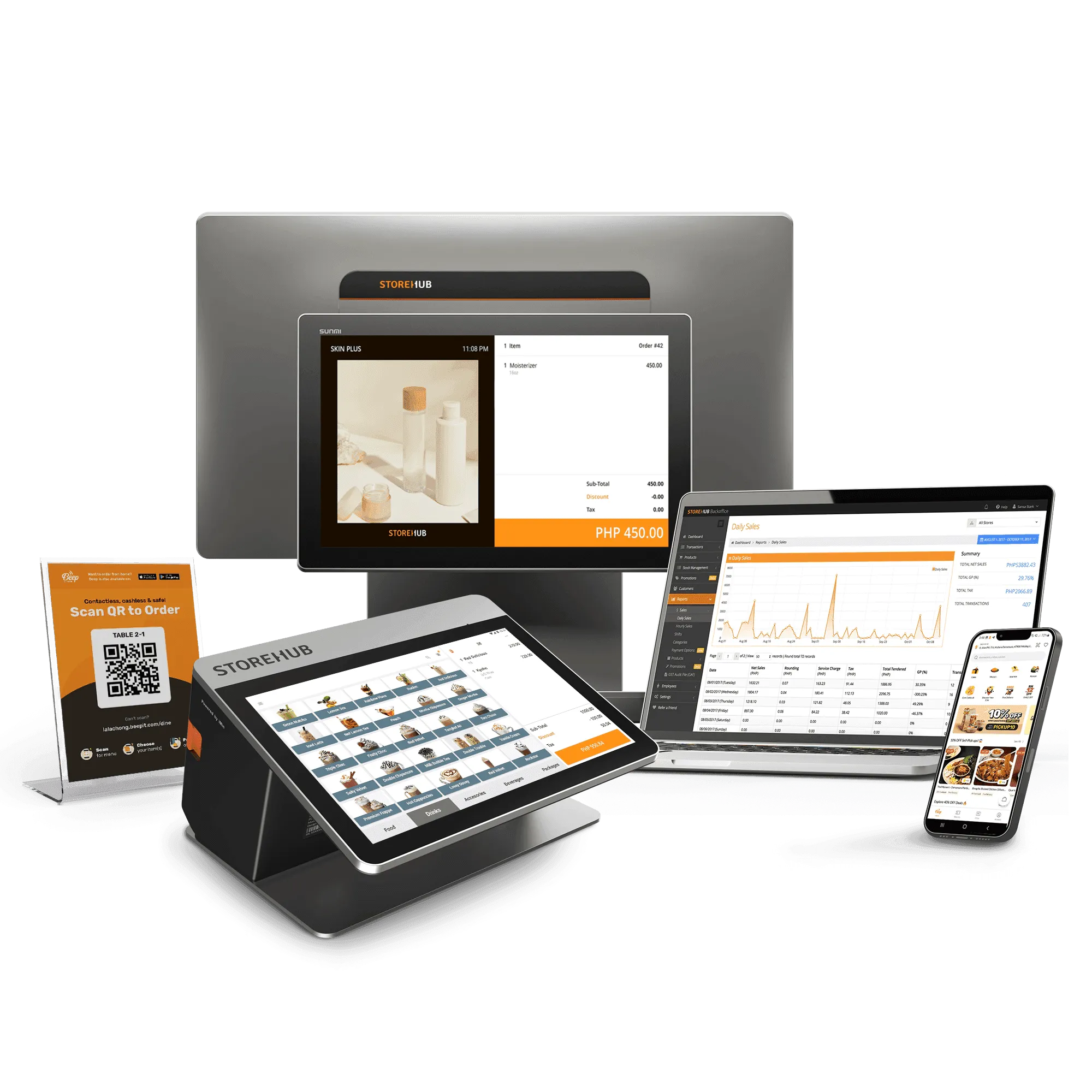
Sales, inventory, and transfers update the moment they happen at any branch. The owner sees a 2 PM sales spike at branch 3, a stock-out alert at branch 5, and a pending transfer to branch 2 from one screen, without calling anyone. A full overview of every location from one screen is what makes audits and investor reporting straightforward for groups running 6 branches like Candid Coffee.
Composite inventory cuts data work by an order of magnitude
StoreHub's recipe-level inventory deducts ingredients per finished item sold, per branch, in real time. The reduction in manual data work is the single most-cited operational shift from multi-branch operators, with back-office reconciliation that used to take a full working day dropping to under 30 minutes.
Remote management from any device
Cloud-based architecture is what makes branch visibility possible from outside the store. An owner running 9 locations like Yardstick Coffee can check each store's data anytime, from any device, instead of having to be everywhere at once. The same holds for owners managing branches while traveling: with a cloud system, the whole operation is one swipe away on a phone.
BIR-accredited at every branch
StoreHub is BIR-accredited at the system level. Each branch generates its own Z-readings, X-readings, e-journals, and Official Receipts in the format BIR examiners expect, automatically. The provider-level accreditation means you do not apply separately as a merchant per branch.
Mall pre-accreditation that adds up across openings
StoreHub is pre-accredited with most major Philippine mall chains. For an F&B group opening branches inside SM, Ayala, or Robinsons, that pre-accreditation removes 30 to 60 days of registration timeline per new location. Across 6 or 9 branches, that adds up to months of unblocked openings.
Reliability that scales with branch count
StoreHub has run at 99.9% uptime for the last 10 years. The reason that matters more at 6 branches than at 1: a system that goes down at peak hour does not just stop one register, it stops six. A local Philippine support team picks up when branch 4 needs help mid-rush.
Built for Filipino multi-outlet F&B operations specifically
The multi-location management hub documents the full multi-outlet feature set. A few specifics worth calling out for Filipino F&B groups.
Branch-level reporting that the bookkeeper can actually use. Reporting analytics breaks down sales, cost, waste, and staff performance per branch and across the group. Investor or franchise reporting, end-of-month consolidation, and same-store-vs-new-store comparisons all run from one dashboard.
Stock transfers as a logged 2-tap operation. Inter-branch transfers create a transfer record on both ends. No phone-call-then-spreadsheet workflow. The audit trail is built in for any branch that runs sister-store fulfillment.
Cloud-first means tablet-of-choice flexibility. Your branches do not all have to run the same hardware. BYOD-capable terminals plus cloud architecture mean a manager can open branch 7 with the iPad they already own, then add proper hardware on the next reorder cycle.
Beep Delivery at 9% commission is a margin floor that adds up at multi-branch scale. Most third-party platforms in the Philippines take 25% to 35% commission on delivery orders. Across 6 branches each doing meaningful delivery volume, the gap between 9% and 30% commission is the difference between profitable and breakeven on the delivery channel. Online ordering setup ships per branch.
Voices from Filipino multi-outlet F&B operators on StoreHub
Behind every multi-branch operation is an owner who decided to scale on their own terms. Three things keep coming up: cutting the back-office data load, seeing every branch without driving to it, and running the group from your phone.
On cutting the back-office data load:
"We used to spend eight hours sorting through data manually. With StoreHub, we get it done in under 30 minutes, freeing up our time for other parts of the business."
Lanz Castillo, Owner of Candid Coffee
→ See StoreHub for multi-outlet operations
On seeing every branch without driving to it:
"Running multiple stores used to be really tough because I couldn't be everywhere at once. With StoreHub's cloud system, I can check data anytime, and it makes my daily decisions so much easier."
Andre Chanco, Co-Founder of Yardstick Coffee
→ Watch Andre Chanco's Yardstick Coffee story on Behind The Counter
On running the group from your phone:
"The (StoreHub cloud-based POS system) really, really helped us and it has given us peace of mind, because at any time, during the day, we can just be on our phones. We also love to travel. So it has helped us while we were traveling. I can just swipe on my phone and have all my business data at my fingertips."
Maxine Kong, Co-founder of Kurimu
→ Read Maxine Kong's Kurimu story
More than 20,000 businesses across Southeast Asia run on StoreHub. The Philippine F&B roster includes Candid Coffee, Yardstick Coffee, Kurimu, The Weekend and Ilaputi in Cebu, Happilee Korean Kitchen, Boxed Blossoms, and others. Each one switched because the system they had wasn't built for the way Filipino F&B operators actually run, through every Saturday peak, every new branch opening, and every BIR filing.
When StoreHub is not the right choice
Like any system, StoreHub fits some merchants better than others. Picture a single-outlet sari-sari store owner in Quezon City running on cash, with one register and no plans to add a second location. For that setup, a free POS like Loyverse on a tablet is the honest recommendation. It's simpler, it's cheaper, and it does what they need.
But if you're already thinking about a second outlet, real-time inventory across branches, BIR-accredited Official Receipts at every register, or remote visibility from your phone on a Saturday afternoon, that's where StoreHub starts to matter, because adding any of those later means re-platforming the whole operation.
StoreHub pricing in the Philippines
Three plans cover most multi-outlet F&B businesses. Multi-location features unlock at Advanced.
Plan | Annual | Best for |
|---|---|---|
Starter | PHP 26,988/yr | Single outlet validating product-market fit |
Advanced | PHP 53,988/yr | Multi-outlet F&B groups (most cafe and restaurant chains) |
Pro | PHP 107,988/yr | 5+ branch operators that want a full-service setup |
A 14-day free trial is available, no credit card required. BIR PTU Registration assistance is PHP 1,000 per registration as an onboarding service. See our pricing page for add-ons, payment processing rates, and multi-year savings.
Frequently asked questions
What is a multi-outlet POS, and why does an F&B operator need one?
A multi-outlet POS is a system that runs every branch on the same back-end, so sales, inventory, staff, and reporting are visible across all locations from one dashboard. The reason it matters for F&B specifically is that ingredient cost, waste, and table-side service quality are decided per branch but managed at the group level. Without a multi-outlet POS, opening your second branch doubles your spreadsheet work; with one, it does not.
How does StoreHub handle inventory across multiple F&B branches?
Inventory syncs in real time across all branches, with composite (recipe-level) tracking for F&B. When you sell a milk tea at branch 3, the milk, tea, sugar, and cup deduct from that branch's stock automatically. Stock transfers between branches are logged. Lanz Castillo of Candid Coffee, who runs 6 branches, called out that the data work that used to take 8 hours now takes under 30 minutes.
Can I monitor all my branches from outside the store?
Yes. Andre Chanco, who runs 9 Yardstick Coffee locations, manages his branches remotely from a single dashboard. Maxine Kong (Kurimu, 5 branches) reports she pulls business data from her phone while traveling. Cloud-based architecture is what makes this work. Local-server POS systems cannot do this.
Does multi-outlet POS work with BIR accreditation in the Philippines?
Yes. StoreHub is BIR-accredited at the system level, and the BIR-required documents (Z-readings, X-readings, e-journals, Official Receipts) generate per-branch automatically. StoreHub is also pre-accredited with most major mall chains in the Philippines, which removes 30 to 60 days of registration delays per new branch you open.
See StoreHub in action
See how StoreHub runs across 20,000+ Southeast Asian businesses, from single-outlet cafés to multi-branch operators, in this short product walk-through.