Taxes come in many shapes and sizes for entrepreneurs in the Philippines, and it’s not as straightforward as the Income Tax Return (ITR) of those who are employed. If you’re a sole proprietor, business owner, or freelancer this can be an even more daunting task because you’ll have to do it yourself or at least be actively involved in the filing process to some extent (if you hire an accountant).
Running a business already demands a lot of mental energy and adding your taxes to your laundry list can make it all the more "taxing". To make this chore easier to manage for thriving entrepreneurs we've put together a comprehensive guide on the things you should know and the steps that you should take to file your taxes.
VAT vs Non-VAT business
Before filing your taxes, you must first determine whether you fall into the VAT business category or the non-VAT. There are different tax rates for the two categories, and knowing where you fit can put you in a better position to comprehend your tax obligations. There are advantages and disadvantages of each category that can help business owners optimize their tax dues.
BIR Registered NON-VAT businesses are those that do not make more than the current limit in annual gross sales or receipts. Currently, BIR’S limit for non-vat businesses was set at ₱3,000,000. VAT businesses on the other hand are those who earn beyond the said limit.
Under the Ease of Paying Taxes (EOPT) Act, regardless of your category, the system has been simplified so that you now only issue an "Invoice" for both goods and services, replacing the old "Official Receipt" as the primary document for services.
TRAIN Law and how its overhauling tax rates
The Tax Reform for Acceleration and Inclusion (TRAIN) Law made some good changes that aim to make the tax system easier to understand and make it fairer for both individuals and businesses.
Starting January 1, 2026, the final phase of the TRAIN Law is fully implemented, with personal income tax rates at their lowest: the 20% bracket has dropped to 15%, providing more take-home pay for small business owners.
Quarterly filing
Before the TRAIN law was passed, businesses had to file percentage taxes every month. Now, percentage taxes will only have to be filed every three months. Under the EOPT Act’s "File and Pay Anywhere" rule, you can now file and pay through any Authorized Agent Bank or software provider without "wrong venue" penalties, even if it's outside your registered RDO. The law also made the BIR Form 2551Q, which is used for quarterly percentage taxes.
Eight percent tax rate
The 8% Gross Income Tax (GIT) rate is the biggest change brought about by the TRAIN Law. This gave small businesses a simpler way of calculating their quarterly taxes. This rate however is only optional, and may not necessarily mean you’ll be paying fewer taxes. It’s more straightforward for sure, and if you’re the type of business owner who doesn’t want to deal with a complicated breakdown of your income to determine your taxes, this is an easier method to do it.
Quarterly percentage tax rates
If you’re the type of business owner who is prudent in auditing your business income and would rather base your taxes on the BIR’s traditional tax rates to cut some corners on your taxes, here are the rates itemized by industry according to the BIR. Take note that the temporary 1% COVID-relief rate has already reverted to the standard 3% for 2026.
Coverage | Taxable Base | Tax Rate |
Non-VAT registered persons under Section 109 (BB) | Gross sales or receipts | 3% |
Domestic carriers and keepers of garages | Gross receipts | 3% |
International air/shipping carriers doing business in the Philippines | Gross receipts on transport of cargo from the Philippines to a foreign country | 3% |
Franchise grantees:
| Gross receipts Gross receipts | 2% 3% |
Overseas dispatch, message or conversation originating from the Philippines | Amount paid for the service | 10% |
Banks and non-bank financial intermediaries performing quasi-banking functions: On interest, commissions and discounts from lending activities as well as income from financial leasing, on the basis of remaining maturities of instruments: | ||
• If maturity period is five years or less | Gross receipts | 5% |
• If maturity period is more than five years | Gross receipts | 1% |
Dividends and equity shares and net income of subsidiaries | Gross receipts | 0% |
Royalties, rentals of property, real or personal, profits from exchange and all other items treated as gross income under Sec. 32 of the Tax Code, as amended | Gross receipts | 7% |
Net trading gains within the taxable year of foreign currency, debt securities, derivatives and other similar financial instruments | Net gains | 7% |
Other non-bank financial intermediaries | Interest, commissions, discounts and all other items treated as gross income under the Tax Code, as amended | 5% |
Interest, commissions, discounts from lending activities, as well as income from financial leasing on the basis of remaining maturities of instruments from which such receipts are derived: | ||
• If maturity period is five years or less | 5% | |
• If maturity period is more than five years | 1% | |
Life Insurance Company/Agent/Corporation (except purely cooperative companies or associations) | Total premiums collected | |
Agents of foreign insurance companies (except reinsurance premium): | ||
Insurance agents authorized under the Insurance Code to procure policies of insurance for companies not authorized to transact business in the Philippines | Total premiums collected | |
Owners of property obtaining insurance directly with foreign insurance companies | Total premiums paid | |
Proprietor, lessee or operator of the following: | ||
Cockpits | Gross receipts | |
Cabarets, Night or Day Clubs, videoke bars, karaoke bars, karaoke televisions, karaoke boxes and music lounges | Gross receipts | |
Boxing exhibitions (except when the World or Oriental Championship is at stake in any division, provided further that at least one of the contenders for World Championship is a citizen of the Philippines and said exhibitions are promoted by a citizen/s of the Philippines or by a corporation/ association at least 60% of the capital of which is owned by said citizen/s) | Gross receipts | |
Professional basketball games (in lieu of all other percentage taxes of whatever nature and description) | Gross receipts | |
Jai-alai and race track | Gross receipts | |
Winnings on horse races | · Winnings or 'dividends' | |
· Winnings from double forecast/quinella and trifecta bets | 4% | |
· Prizes of owners of winning race horses | 10% |
How to file your taxes?
There are three ways for you to file your taxes in the Philippines:
Manual filing
A major update for 2026 is that you no longer need to pay the ₱500 Annual Registration Fee (Form 0605) every January, as it has been officially abolished under the Ease of Paying Taxes (EOPT) Act.
For individuals earning income only as employees, you will need to fill up BIR Form 1700.
For Micro and Small taxpayers earning below ₱20 million, the ITR is now simplified to a maximum of two pages using the new BIR Form 1701-MS.
For individuals who are self-employed or deriving mixed-income who do not qualify for the simplified form, you will need to fill up BIR Form 1701.
Note: Under the EOPT Act, you only need to prepare two (2) copies: one for the BIR and one as your received copy. The following documents are also needed:
Certificate of Income Tax Withheld on Compensation (BIR Form 2316)
Certificate of Creditable Tax Withheld at Source (BIR Form 2307): This is the most common requirement for freelancers and contractors to prove the taxes withheld by their clients.
Tax debit memo
Proof of prior year’s excess tax credits, and
Certificate of Income Payments not Subjected to Withholding Tax (BIR Form 2304).
Electronic Filing and Payment System
The eFPS is a complete online tax filing process. This includes payments made online through the BIR website for attachments and taxes owed to the government. If a taxpayer wants to use the BIR eFPS services, they have to sign up through the BIR website to find out what they need to do. They also have to keep an online banking service that works with the eFPS.
However, filing through the eFPS isn’t for everyone, this is only for businesses who fall into the following categories:
Large taxpayers who are duly notified by the BIR;
The top 20,000 private corporations duly notified by the BIR;
The top 5,000 individual taxpayers duly notified by the BIR;
Taxpayers who wish to enter into contracts with government offices;
Corporations with paid-up capital stock of ₱10 million;
Entities registered with the Philippine Economic Zone Authority (PEZA) and those located within Special Economic Zones;
Government offices, insofar as remittance of withheld value-added tax (VAT) to business tax is concerned.
A major update for 2026 under the Ease of Paying Taxes (EOPT) Act is the "File-and-Pay Anywhere" rule. Even for mandatory eFPS filers, if the system is offline or unavailable, you are now legally allowed to file and pay through any Authorized Agent Bank (AAB), Revenue Collection Officer (RCO), or authorized tax software provider without incurring "wrong venue" penalties.
Electronic BIR Forms
The Electronic BIR Forms, also called eBIRForms, were mostly for taxpayers who don't use eFPS and their licensed tax agents could file their taxes in the Philippines in an easier and more accessible way. Revenue Regulation No. 6-2014 says that it must be done.
There are both offline and online parts to eBIRForms. The offline platform, which you can download and install on your computer, is the one that most people use. Their offline platform is a tax-preparation program that lets taxpayers fill out their tax forms and send them to the BIR without leaving the system. This 2026, the system has been updated to include the simplified Form 1701-MS for Micro and Small taxpayers.
A major update for 2026 is the registration of Books of Accounts. Under the latest BIR guidelines, the registration of bound loose-leaf and computerized books of accounts is now done through the Online Registration and Update System (ORUS). Instead of manual stamping, you will now receive a QR Code stamp after a successful online registration, which you must affix to the first page of your books.
Tax duties and number crunching all need a lot of work to accomplish, the least that you could do is to automate everything else that needs computing. While tax filing is purely reliant on the BIR’s available channels (which are still less than high-tech by the way), your invoice, inventory, audits, and income reports don't have to follow the same fate!
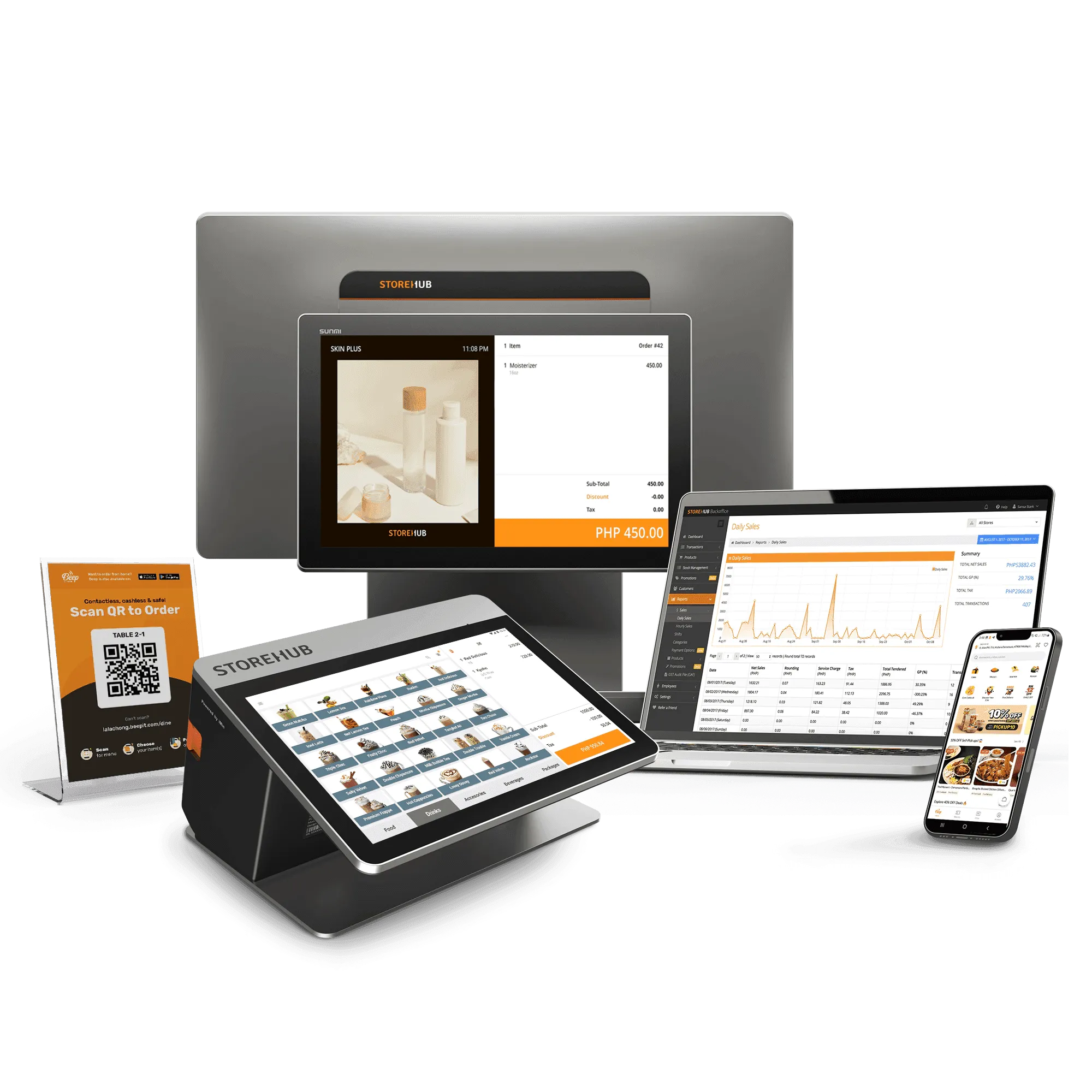
One easy way to automate your business, especially the paperwork, is by adding a modern-day POS in the equation like StoreHub. Take control of your business with ease, and let our POS do the number crunching, analysis, and reports with just a few clicks.
Empower your business with StoreHub’s all-in-one management system today - a BIR-accredited POS system that lets you do more than just process payments and orders!
Source: Bureau of Internal Revenue (BIR)