At a Glance: |
|---|
StoreHub is a cloud-based, BIR-accredited POS for Philippine convenience stores and mini marts: barcode checkout that keeps the line moving, real-time inventory across hundreds of SKUs, and clock-in records with timesheet reports that make every shift accountable. A 24/7 store runs on speed and on visibility into the shifts the owner does not watch. More than 20,000 businesses across Southeast Asia run on StoreHub, backed by a local Philippine support team. |
For convenience stores and mini marts in the Philippines, the POS choice comes down to two questions. Can it keep the line moving when a tricycle driver, a nurse coming off shift, and a student buying load are all waiting at 6 am? And can it tell you exactly what happened during the shifts you were not there to see? StoreHub is cloud-based, BIR-accredited, scans barcodes straight into the sale, and tracks every shift with clock-in records and timesheet reports.
The shape of the problem is different from a boutique or a cafe. A convenience store sells small baskets at high frequency, morning to midnight and often straight through. Margins per item are thin, so the store earns on volume and loses money quietly: slow queues, miscounted stock, shift gaps nobody can explain. The POS is either the control system for all of that or just an expensive cash drawer.
This guide covers what extended-hours retail in the Philippines actually requires from a POS, where the daily friction lives, and how StoreHub handles it. (If your store leans curated rather than everyday goods, the specialty store POS guide covers that format.)
Are these problems familiar in your convenience store?
The 7 am line decides who comes back
A convenience store's whole edge is speed. If the cashier is typing prices by hand, hunting a price list for the one item without a barcode, or doing drawer math on a PHP 500 bill, the line stalls. Customers near an office, a school, a terminal, or a hospital pick their store by how fast they get out the door, and the payday rush every 15th and 30th is exactly when a slow counter costs the most.
Shift handovers hide the leaks
Most mini marts run two or three cashier shifts. The problems live in the gaps between them: a drawer short a few hundred pesos with no way to tell which shift, stock that left the shelf without crossing the scanner, a void or a discount nobody remembers giving. Without staff clock-in records and per-shift readings, every discrepancy becomes a general argument instead of a specific answer.
Hundreds of SKUs, restocked by gut feel
Even a small store carries hundreds of SKUs across dozens of suppliers. When the count lives in a notebook, you find out the best-selling coffee sachets ran out only when a customer asks, and the next delivery doubles up on what the shelf did not need. In this format, stock accuracy is the difference between selling and apologizing.
BIR paperwork at convenience-store volume
High transaction counts mean the BIR paper trail has to run itself: an Official Receipt on every sale, X-readings at shift close, a Z-reading at end of day, e-journals filed without anyone retyping. The counter also has to apply Senior Citizen and PWD discounts correctly on the OR, every time, without slowing the line. A store running a non-accredited POS "for now" is building an audit problem one small sale at a time.
What to look for in a convenience store POS in the Philippines
Before picking a system, check that it covers all of these:
Barcode checkout built for speed. Scan, total, pay, next. The register should run on hardware that lasts a 16-hour day, with barcode scanners and thermal printers supported.
Real-time inventory with low-stock alerts. Every sale deducts stock the moment it scans, and reorder thresholds flag the fast movers before the shelf goes empty.
Staff time records and timesheet reports. Clock-ins and clock-outs tracked directly from the POS, with timesheet reports, so cash and voids trace to a shift instead of a guess.
Cashless payments at the counter. GCash, Maya, GrabPay, QR Ph, and bank payment apps are everyday payments at Philippine counters now; the POS should take all of them without slowing the line.
BIR accreditation at the system level. Official Receipts, X-readings, Z-readings, and e-journals generated automatically, with Senior Citizen and PWD discounts automated on the receipt.
A path to a second outlet. If outlet two is anywhere in the plan, pick a system that can run both from one BackOffice instead of starting over later.
A local Philippine support team. A store that closes at midnight, or never closes, cannot wait for office hours when the register acts up at 11 pm.
How StoreHub solves these for Filipino convenience stores
Checkout that holds at rush hour
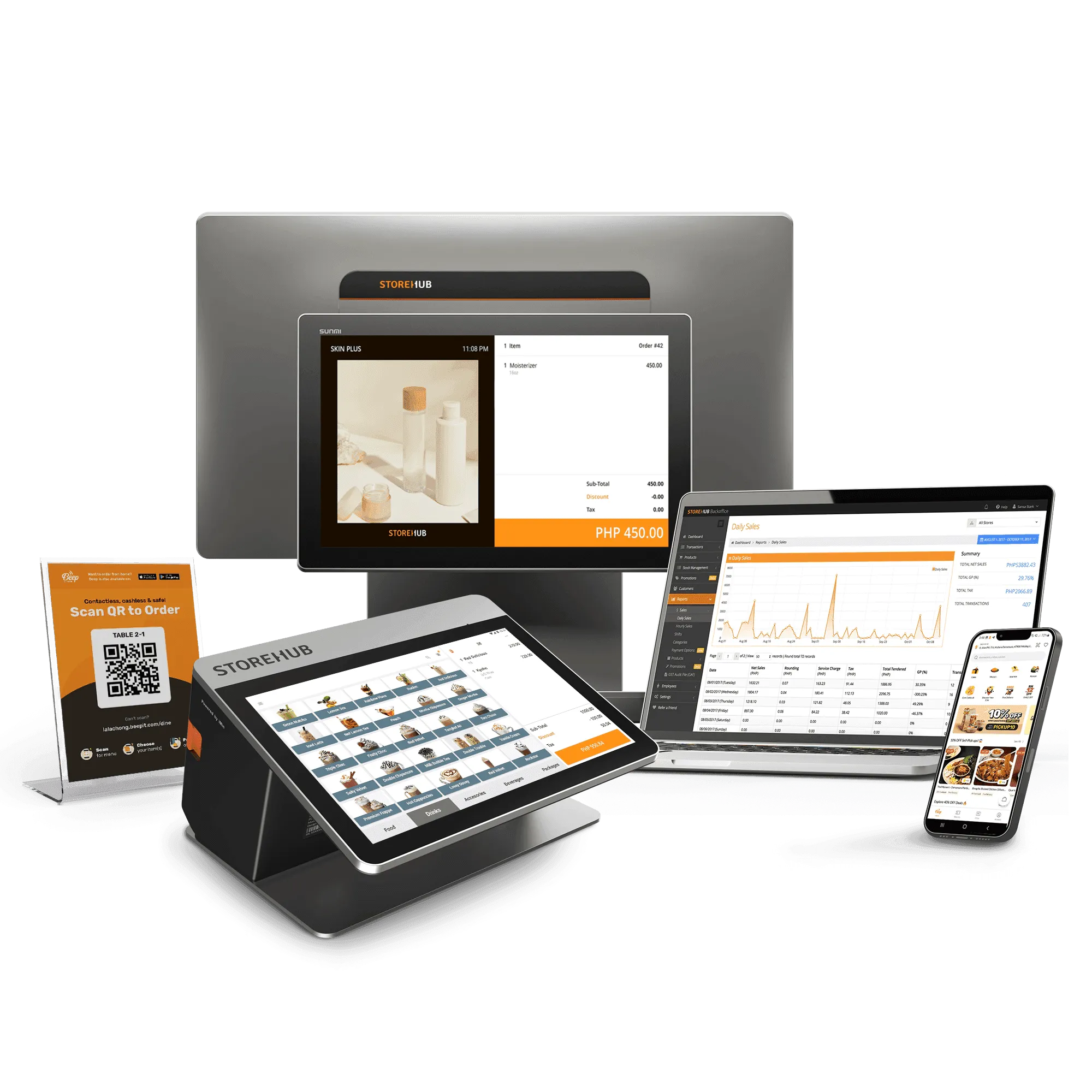
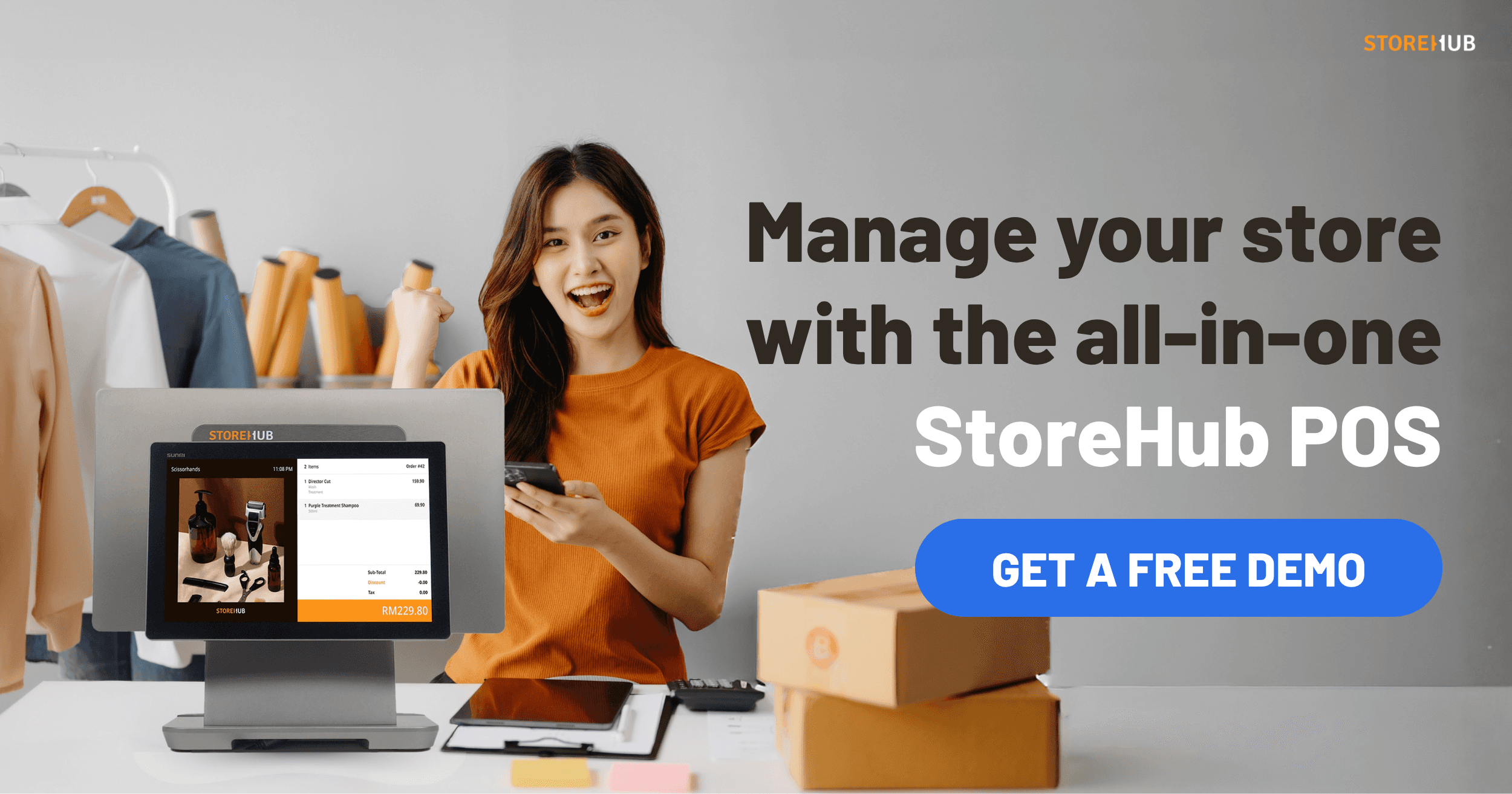
StoreHub's point-of-sale runs on iPad or Android and works with barcode scanners and thermal printers, so the standard flow is scan, scan, total, paid. On the bigger-format side of the same retail family, StoreHub's grocery and supermarket page cites a 60% reduction in queue time. A mini mart gets the same mechanics at smaller scale: fewer taps per sale, fewer manual price lookups, a faster line at 7 am and on payday.
Inventory that counts itself while you sell
Inventory Management deducts stock in real time as each item scans and flags anything that hits its reorder threshold. Candid Coffee, a Philippine coffee business on StoreHub, cut manual stock work from eight hours to under 30 minutes; the same mechanics, live counts instead of notebook tallies, are what keep a mini mart's fast movers on the shelf. For the method side, our guide to effective inventory management for retail pairs well with this.
Shift handovers with a paper trail
Every cashier clocks in and out on the POS, with staff time records and timesheet reports. Pair that with X-readings at every shift close, and the handover conversation changes: not "who was on duty last night," but "this shift, this drawer, this number." Shrinkage does not disappear on its own, but it stops being invisible.
Cashless without the drawer math
StoreHub accepts GCash, Maya, GrabPay, QR Ph, and bank payment apps alongside cash, at competitive payment rates. Every digital payment lands in the same sales record as the cash sales, so end-of-day reconciliation is one report, not a stack of e-wallet screenshots checked against a notebook.
BIR compliance that runs in the background
StoreHub is BIR-accredited at the system level. Official Receipts print automatically, X-readings, Z-readings, and e-journals generate per BIR requirements, and Senior Citizen and PWD discounts are automated on the OR, no manual math at the counter. PTU registration for your store is handled as an onboarding service, and mall pre-accreditation saves 30 to 60 days versus registering a system yourself.
Reliability for a store that barely closes
StoreHub runs at 99.9% uptime. The support team is local and easy to reach when the register misbehaves and the line does not care.
Built for Filipino convenience stores specifically
The Convenience Store hub documents the full feature set for this format. A few specifics worth calling out.
Small-basket speed as the default flow. The register is built around scan-and-go transactions, not table service: barcode first, with a fast way to ring up the items that never had one (bread from the local bakery, eggs, ice).
Senior Citizen and PWD discounts on the OR. Automated at the counter and printed on the Official Receipt, with no manual computation while the line watches.
Staff time records for rotating staff. Convenience stores run on part-timers and rotating shifts. Clock-ins and clock-outs are tracked per staff member directly from the POS, without a separate logbook.
BackOffice on your phone. Cloud-based means the day's numbers are wherever you are. You can check sales at midnight without driving to the store.
The second-outlet path. When the first store works, the second one usually follows. StoreHub's multi-location management is built to manage 2 or 200 outlets from one dashboard, with one product list and one price list.
Voices from Filipino retailers on StoreHub
StoreHub's named Philippine retail voices run specialty counters rather than mini marts, so read them for what they are: proof of how the platform behaves at a retail counter, not convenience-store case studies. What stands out is a system you trust enough to build a second business on.
On a system you can build a second business on:
"I trust StoreHub's products and services. They are reliable and have made my life easier. If I start another venture, I would still choose StoreHub and I highly recommend it to others."
Jem Tinsay, Owner of Boxed Blossoms (floral retail) and Vine Cafe Lounge, Makati / Alabang
More than 20,000 businesses across Southeast Asia run on StoreHub. The Philippine retail roster includes Boxed Blossoms, Vine Cafe Lounge, Kurimu, and others. Each one runs its counter on the same platform, through every early-morning delivery, every shift handover, and every BIR filing. The reliability angle shows up in public reviews too: a Google review from Kim Pena on the StoreHub Philippines homepage reads, "Been using StoreHub for 2 years and never encountered issues with POS. The system is straight forward and easy to use."
When StoreHub is not the right choice
Like any system, StoreHub fits some stores better than others. Picture a home-front sari-sari store in Marikina: one window, cash in a biscuit tin, sixty-odd items the owner can count from memory, and no hired staff. For that setup, a notebook and a free POS app are the honest recommendation. The volume does not justify the system, and the owner is the shift.
But if you're running a real convenience format, hired cashiers across two or three shifts, hundreds of barcoded SKUs, a BIR registration to keep clean, and maybe a second location in next year's plan, that's where StoreHub starts to matter, because speed, shift accountability, and stock accuracy are exactly the places a casual setup leaks money.
StoreHub pricing in the Philippines
Three plans cover most convenience stores. Starter fits a single-register store; Advanced adds the inventory depth and multi-outlet management growing mini marts end up needing.
Plan | Annual | Best for |
|---|---|---|
Starter | PHP 26,988/yr | Single-register stores getting off manual receipts |
Advanced | PHP 53,988/yr | Stores with serious SKU counts or a second outlet coming |
Pro | PHP 107,988/yr | Multi-outlet groups with larger operations |
A 14-day free trial is available, no credit card required. BIR PTU Registration assistance is PHP 1,000 per registration as an onboarding service. See our pricing page for add-ons, payment processing rates, and multi-year savings.
Frequently asked questions
What is the best POS system for a convenience store in the Philippines?
The practical test is four things: barcode checkout fast enough for rush hour, real-time inventory across hundreds of SKUs, clock-in records and timesheet reports that make each shift accountable, and BIR accreditation at the system level. StoreHub covers all four in one cloud-based platform, with a local Philippine support team.
Can StoreHub handle barcode scanning for hundreds of SKUs?
Yes. StoreHub runs on iPad or Android and works with barcode scanners and thermal printers. Every scan deducts stock in real time, and low-stock alerts flag fast movers before the shelf goes empty. Items without barcodes can still be rung up at the register.
How does StoreHub help with shift handovers and cash discrepancies?
Staff clock-ins and clock-outs are tracked directly from the POS, timesheet reports show what happened while you were away, and X-readings can be run at every shift close. A short drawer or an unexplained void traces to a specific shift instead of turning into a general argument.
Is StoreHub BIR-accredited for convenience stores?
Yes, at the system level. Official Receipts, X-readings, Z-readings, and e-journals generate automatically per BIR requirements, and Senior Citizen and PWD discounts are automated on the receipt. PTU registration assistance is available as an onboarding service at PHP 1,000 per registration.
Does StoreHub accept GCash and other cashless payments?
Yes. StoreHub accepts GCash, Maya, GrabPay, QR Ph, and bank payment apps alongside cash. Digital payments land in the same sales report as cash sales, so end-of-day reconciliation is one report instead of screenshots checked against a notebook.
See StoreHub in action
See how StoreHub runs across 20,000+ Southeast Asian businesses, from single-register stores to multi-outlet retail groups, in this short product walk-through.